Longevity has become one of the most recurring concepts across the fields of health, nutrition and well-being. However, far from being a passing trend, it reflects an extensive demographic, scientific and economic shift that is redefining how we understand prevention, product formulation and ingredient innovation.
Today, talking about longevity means going beyond “living longer” and focusing on how to preserve functionality, autonomy and quality of life over time.
According to data from the World Health Organization (WHO) and the United Nations, population ageing is a global, accelerated and structural phenomenon. It is estimated that by 2030, one in six people worldwide will be over the age of 60 and that by 2050, the population in this age group will exceed 2.1 billion. The cohort aged 80 and above will be the fastest-growing segment, tripling to reach 426 million people (1).
This shift is not limited to developed countries. Approximately 80% of the older population will live in low- and middle-income countries, increasing pressure on healthcare systems and reinforcing the need for effective and sustainable long-term preventive strategies (1).
From a scientific perspective, ageing is defined as the progressive accumulation of cellular and molecular damage, leading to a gradual loss of functional capacity and an increased risk of chronic diseases (2).
This process is multifactorial and multisystemic. Key biological mechanisms involved include mitochondrial dysfunction, telomere shortening, cellular senescence associated with the inflammatory SASP phenotype (inflammaging), genomic instability derived from DNA damage, gut dysbiosis and musculoskeletal degeneration, such as sarcopenia and loss of bone density (2–4).
These mechanisms explain why longevity cannot be addressed through a single approach, but rather as a complex process requiring integrated, evidence-based interventions.
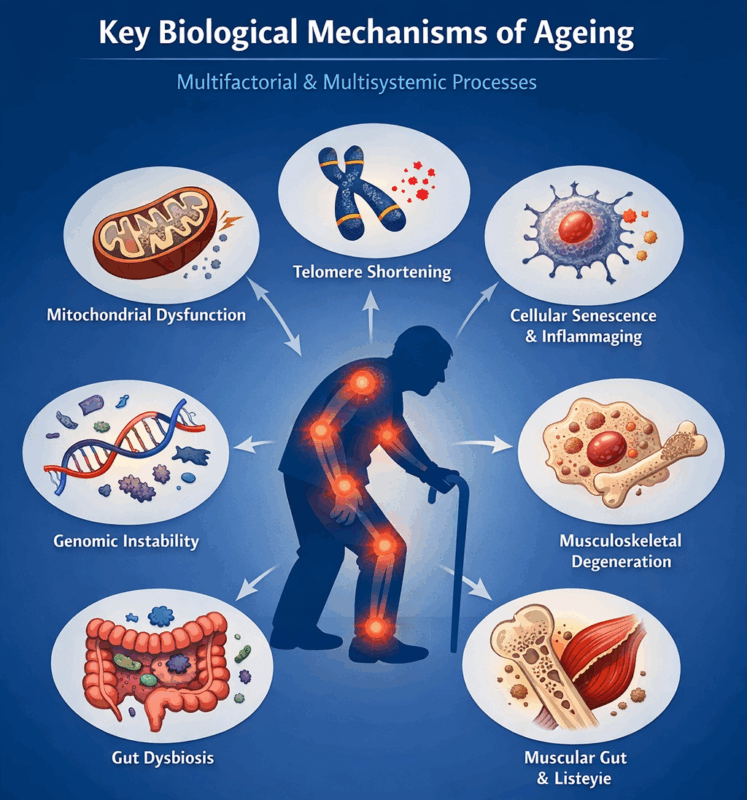
Figure 1. Key biological mechanisms of ageing. Adapted from López-Otín et al. (2013) and subsequent literature (2–4).
Advances in scientific knowledge have driven a paradigm shift. Longevity is no longer viewed solely through the lens of “anti-ageing,” but rather through lifelong health strategies aimed at preserving physical, cognitive and metabolic function for longer periods of life (3,4).
In this context, key areas of scientific and market interest include:
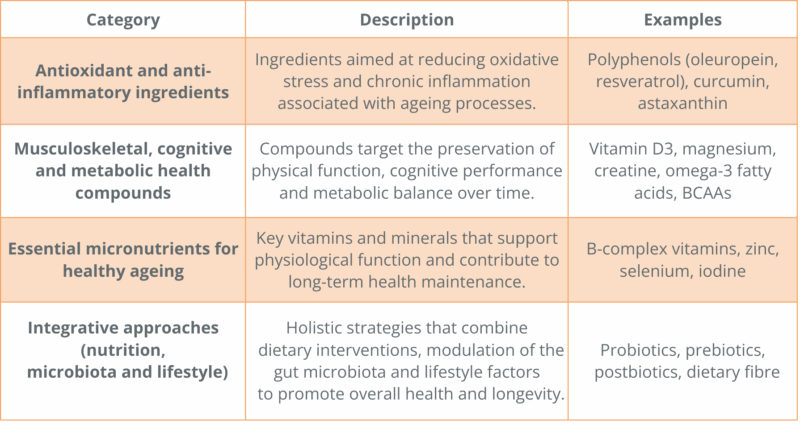
Sources: Rivero-Segura NA et al., Nutrients 2024;16(17):2835; Carvalho BG et al., Nutrition
Research 2025; Chopra AS et al., Pharmacological Research 2022;175:106001.
a strategic Relationship
The relationship between the longevity market and nutraceuticals is close and bidirectional. The longevity market includes products, interventions and technologies designed to extend health span and delay the beginning of age-related diseases. Within this framework, nutraceuticals, defined as bioactive compounds providing benefits beyond basic nutrition, have emerged as one of the leading development categories due to their ability to modulate key processes such as oxidative stress, chronic inflammation and cellular senescence (5–7).
The growth of the nutraceutical market is driven by population ageing, increasing health awareness and the demand for preventive strategies that help maintain functionality and quality of life in later years. A broad range of compounds is currently under investigation for their potential geroprotective effects, meaning their capacity to delay or prevent age-related pathologies (5,8).
However, while promising preclinical and epidemiological data exist, robust clinical evidence in humans remains limited for many ingredients. This underscores the importance of advancing towards formulations based on well-defined mechanisms of action, high-quality clinical studies and clear regulatory frameworks (6).
Scientific interest in longevity is also reflected in economic data. Global investment in this sector is growing at double- and triple-digit rates, driven by post-pandemic prevention, the development of health technologies, artificial intelligence and biomarker-based personalisation. For brands and developers, this represents a clear opportunity to innovate with rigour, supported by scientifically validated ingredients, coherent formulations and credible messaging.
Everyone is talking about longevity because it is no longer a trend, but a biological, demographic and strategic reality. Understanding its scientific foundations is essential to developing solutions that meet the needs of a population that does not simply want to live longer, but to live better.
Longevity is not improvised.
It is built on science, evidence and long-term vision.
Subscribe to our newsletter…
…or find our ingredients in the following product portfolio!
You are currently viewing a placeholder content from YouTube. To access the actual content, click the button below. Please note that doing so will share data with third-party providers.
More InformationYou are currently viewing a placeholder content from Hubspot Embedded Content. To access the actual content, click the button below. Please note that doing so will share data with third-party providers.
More InformationYou are currently viewing a placeholder content from HubSpot. To access the actual content, click the button below. Please note that doing so will share data with third-party providers.
More InformationYou are currently viewing a placeholder content from Hubspot Meetings. To access the actual content, click the button below. Please note that doing so will share data with third-party providers.
More Information