Longevity
Mitochondria: the Energy Powerhouse of the Cell
Mitochondria are small structures present inside our cells and are commonly known as the cellular energy powerhouse. This nickname is no coincidence: their main function is to produce most of the chemical energy that the cell needs to live and function properly [1].
To do this, mitochondria harness the energy contained in the nutrients we obtain from food, mainly sugars and fats and transform it into a form usable by the cell. This energy is stored in a molecule called ATP (adenosine triphosphate), which acts as the true cellular energy currency: a kind of rechargeable battery that the cell uses to carry out its vital processes [1].
In addition to their energetic role, mitochondria exhibit very distinctive characteristics. They possess their own DNA, known as mitochondrial DNA, which in humans is inherited exclusively through the maternal line. This feature reflects their evolutionary origin and makes them unique organelles within the cell [2].
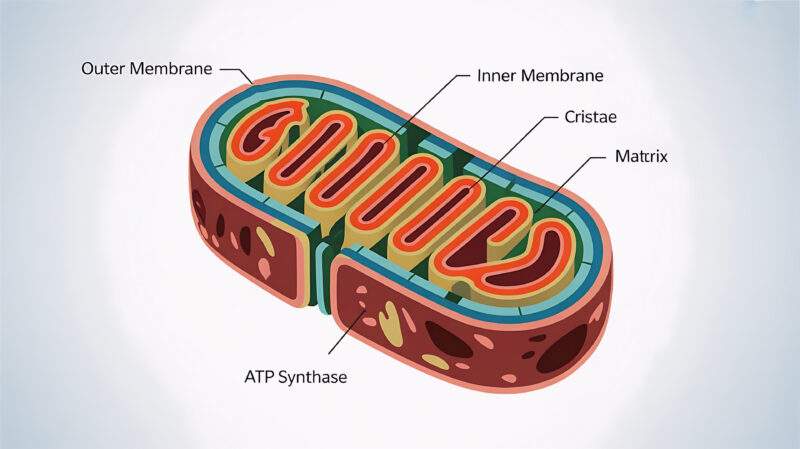
From a structural point of view, mitochondria are surrounded by a double membrane and usually have an elongated shape. Although their size is microscopic, their number within the cell can vary enormously. Cells with a high energy demand, such as muscle or liver cells, can contain up to thousands of mitochondria, whereas those with lower energy requirements harbor a smaller number [3].
The more energy a cell needs, the greater the number of mitochondria it contains.
Energy Production: How these organelles Powerhouses Function
The main function of these organelles is the production of usable energy. This process, known as cellular respiration, can be compared to a carefully controlled combustion [4].
During cellular respiration, mitochondria oxidize nutrients derived from the diet, such as glucose, fatty acids and even certain amino acids, using oxygen. As a result, they generate ATP and release water and carbon dioxide as by-products [1,4].
This process takes place through a series of highly coordinated chemical reactions that occur in different regions of the mitochondrion: some occur in the mitochondrial matrix and others in the inner membrane, where the respiratory chain is located. Without the need to go into complex biochemical details, it is sufficient to note that, thanks to these reactions, mitochondria produce most of the ATP that the cell needs to move, divide, synthesize molecules and remain alive [1,4].
ATP is especially efficient because it allows energy to be stored and released immediately. When the cell requires energy, ATP is degraded and releases it; subsequently, the mitochondrion can “recharge” it again. This continuous cycle constitutes the basis of cellular energy metabolism and explains why ATP is known as the energy currency of life [1].
Beyond Energy: Key Functions of Mitochondria
Far from being simple energy generators, mitochondria act as true centers of integration and control of cellular activity, playing a leading role in metabolism and cellular regulation [3].
Among their most prominent functions are [2,3,5,6]:
1. Metabolism and synthesis of molecules
Mitochondria participate in key metabolic pathways and contribute to the synthesis of essential compounds. In certain cell types, they are involved in the production of amino acids and in the synthesis of steroid hormones from cholesterol, providing fundamental components for the proper functioning of the organism.
2. Calcium regulation and cellular signaling
Furthermore, mitochondria function as calcium reservoirs. Calcium is an ion that is captured and released in a controlled manner by mitochondria, helping to maintain cellular balance and regulate internal cellular communication.
3. Control of programmed cell death (apoptosis)
Of particular relevance is mitochondria’s role in apoptosis, the process by which damaged or unnecessary cells are eliminated in an orderly manner. When a cell is severely affected, mitochondria release signals that activate this controlled self-destruction, protecting tissues and the organism as a whole. For this reason, they are considered true centers of cellular decision-making.
These versatile functions explain why mitochondria are essential for maintaining cellular homeostasis, adapting metabolism and cellular responses to different internal and external conditions.
Importance of Mitochondria in Health and Disease
Given their relevance, the correct functioning of mitochondria is fundamental for cellular and organismal health. When these structures do not function properly, energy production is compromised and cells begin to lose their capacity to perform basic functions. Organs with high energy demand, such as the brain, heart, muscles and liver, are usually the first to be affected [2].
There are numerous mitochondrial diseases caused by alterations in mitochondrial DNA or in nuclear genes that encode mitochondrial proteins. Although they are rare, these pathologies often affect tissues with high energy demand and can manifest through neurological, muscular and metabolic symptoms [2].
Moreover, even outside the context of rare genetic diseases, mitochondrial dysfunction has been associated with aging and with neurodegenerative diseases such as Alzheimer’s or Parkinson’s disease, as well as with various cardiovascular pathologies. The damage accumulated through oxidative stress and other factors can progressively reduce mitochondrial efficiency, promoting cellular deterioration over time [7,8].
Mitochondria live up to their reputation as the energy powerhouse of the cell, as they provide the ATP required for virtually all biological processes. However, their role goes far beyond energy production: they regulate metabolism, participate in cellular signaling and determine cell fate when circumstances require it. Caring for our health at its most basic level largely involves caring for our mitochondria. These tiny energy factories work silently but continuously, sustaining life cell by cell, beat by beat [7,8].
Are you looking for the right ingredients?
Subscribe to our newsletter…
…or find our ingredients in the following product portfolio!
References
- Boyer, P. D. (1997). The ATP synthase—A splendid molecular machine. Annual Review of Biochemistry, 66, 717–749. https://doi.org/10.1146/annurev.biochem.66.1.717
- Glover, H. L., Schreiner, A., Dewson, G., & Tait, S. W. G. (2024). Mitochondria and cell death. Nature Cell Biology, 26, 1434–1446. https://doi.org/10.1038/s41556-024-01429-4
- Green, D. R., & Reed, J. C. (1998). Mitochondria and apoptosis. Science, 281(5381), 1309–1312. https://doi.org/10.1126/science.281.5381.1309
- Kauppila, T. E. S., Kauppila, J. H. K., & Larsson, N.-G. (2017). Mammalian mitochondria and aging: An update. Cell Metabolism, 25(1), 57–71. https://doi.org/10.1016/j.cmet.2016.09.017
- López-Otín, C., Blasco, M. A., Partridge, L., Serrano, M., & Kroemer, G. (2013). The hallmarks of aging. Cell, 153(6), 1194–1217. https://doi.org/10.1016/j.cell.2013.05.039
- Spinelli, J. B., & Haigis, M. C. (2018). The multifaceted contributions of mitochondria to cellular metabolism. Nature Cell Biology, 20(7), 745–754. https://doi.org/10.1038/s41556-018-0124-1
- Suomalainen, A., & Nunnari, J. (2024). Mitochondria at the crossroads of health and disease. Cell, 187(11), 2601–2627. https://doi.org/10.1016/j.cell.2024.04.041
- Vercellino, I., & Sazanov, L. A. (2022). The assembly, regulation and function of the mitochondrial respiratory chain. Nature Reviews Molecular Cell Biology, 23, 141–161. https://doi.org/10.1038/s41580-021-00415-0