Longevity
Antioxidants and Inflammation: Why they matter for Healthy Aging
Aging is a natural and inevitable process. However, the way we age is influenced by far more than the mere passage of time. Factors such as nutrition, physical activity, sleep quality, stress levels, and overall health status all play a role in determining how our cells respond and adapt over the years.
Over the past few decades, research has increasingly focused on the biological mechanisms that contribute to aging. Among these, oxidative stress and chronic low-grade inflammation have emerged as two key players. Although distinct processes, they are closely interconnected and may contribute to the progressive decline in cellular function associated with aging (1,2).
This interaction has led to the concept of inflammaging, a term used to describe the persistent, low-grade inflammatory state that can develop with age and is now considered one of the hallmarks of biological aging (3).
What is Oxidative Stress?
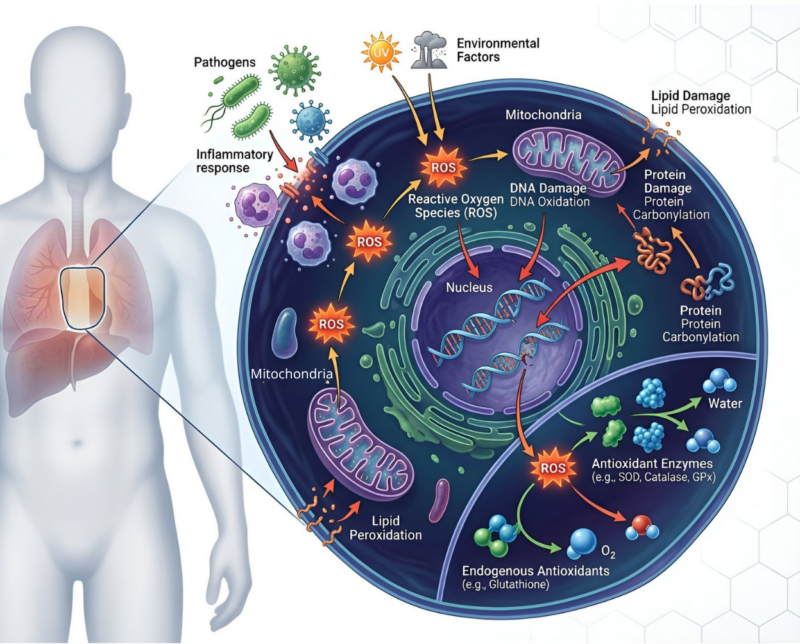
Our bodies naturally produce molecules known as reactive oxygen species (ROS). These molecules are generated as part of normal cellular metabolism, although their production can also increase in response to external factors such as pollution, tobacco smoke, ultraviolet radiation, unbalanced diets and various forms of physiological stress.
Under normal conditions, ROS play important roles in cellular signaling processes. However, when their production exceeds the body’s antioxidant capacity to neutralize them and maintain balance, a condition known as oxidative stress occurs (4,5).
When sustained over time, oxidative stress can damage essential cellular structures, including DNA, proteins, membrane lipids, mitochondria and even the systems involved in cellular repair and signaling. The progressive accumulation of this damage is considered one of the biological mechanisms underlying aging and has been associated with cardiometabolic disorders, neurodegenerative diseases and other age-related conditions (1,5).
Inflammation and Oxidation: A Two-Way Dialogue
Oxidative stress and inflammation are not independent phenomena but rather closely interconnected processes. Excessive ROS production can activate inflammatory signaling pathways, while chronic inflammation can further promote the generation of reactive species. As a result, both mechanisms may reinforce one another, creating a self-perpetuating cycle that disrupts cellular homeostasis (2,4).
As we age, changes also occur in the immune system, mitochondrial function, gut microbiota and tissue repair mechanisms. These alterations may contribute to the persistence of low-grade inflammatory signals, even in the absence of acute infection. This phenomenon, known as inflammaging, should not be viewed as a specific disease but rather as a biological environment that may influence multiple aging-related processes (2,3).
For this reason, a significant portion of current research focuses on understanding how to simultaneously support oxidative balance, immune regulation and cellular function.
What do Antioxidants do?
Traditionally, antioxidants have been defined as molecules capable of neutralizing free radicals. Today, however, we know that their role extends far beyond this function. In addition to helping control oxidative stress, many bioactive compounds can influence cellular pathways involved in stress response, inflammation, energy production and cellular adaptation (4,6).
Key mechanisms include:
- Activation of endogenous antioxidant defenses.
- Cellular stress response regulation.
- Mitochondrial function support.
- Modulation of inflammatory mediators.
- Maintenance of redox balance.
Among these pathways, the transcription factor NRF2 stands out as one of the major regulators of the cellular antioxidant response. Likewise, pathways such as NF-κB play a central role in the regulation of inflammatory processes. The interaction between specific bioactive compounds and these signaling pathways represents one of the most active areas of research in healthy aging (6).
The term antioxidant encompasses molecules with very different chemical structures, bioavailability profiles and mechanisms of action. Furthermore, antioxidant activity observed in a chemical assay does not necessarily translate into the same biological effects within the human body.
Bioactive Ingredients of Interest in Healthy Aging
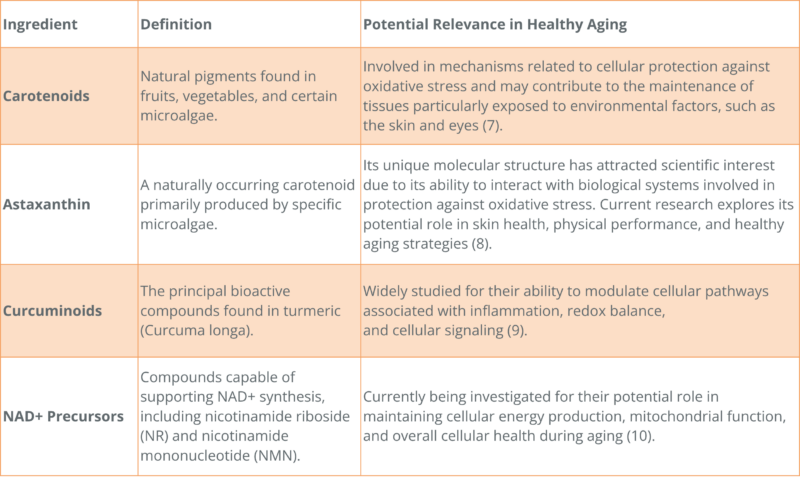
Growing knowledge of the biological mechanisms involved in aging has fueled interest in a variety of bioactive compounds that may help support long-term cellular health. Among the most widely studied are carotenoids, astaxanthin, curcuminoids and NAD+ precursors, each with distinct mechanisms of action and areas of investigation.
Conclusion
Aging is a complex process driven by multiple interconnected biological mechanisms. Among them, the balance between oxidative stress and inflammation appears to play a particularly important role in maintaining cellular function throughout life.
Although many questions remain unanswered, current scientific evidence suggests that specific bioactive compounds may help support the body’s natural protective and adaptive mechanisms. As a result, interest in science-backed ingredients continues to grow as part of nutritional strategies aimed at promoting healthy and active aging.
Are you looking for the right ingredients?
Subscribe to our newsletter…
…or find our ingredients in the following product portfolio!
References
- Rusu, M. E., Fizeșan, I., Vlase, L., & Popa, D. S. (2022). Antioxidants in age-related diseases and anti-aging strategies. Antioxidants, 11(10), 1868.
- Furman, D., Campisi, J., Verdin, E., Carrera-Bastos, P., Targ, S., Franceschi, C., et al. (2019). Chronic inflammation in the etiology of disease across the life span. Nature Medicine, 25(12), 1822-1832.
- Franceschi, C., Garagnani, P., Parini, P., Giuliani, C., & Santoro, A. (2018). Inflammaging: a new immune-metabolic viewpoint for age-related diseases. Nature Reviews Endocrinology, 14(10), 576-590.
- Altanam, S. Y., Darwish, N., & Bakillah, A. (2025). Exploring the interplay of antioxidants, inflammation, and oxidative stress: Mechanisms, therapeutic potential, and clinical implications. Diseases, 13(9), 309.
- Dossena, S., & Marino, A. (2024). Oxidative stress and antioxidants in aging. Antioxidants, 13(11), 1288.
- Manful, C. F., Fordjour, E., Ikumoinein, E., Abbey, L., & Thomas, R. (2025). Therapeutic strategies targeting oxidative stress and inflammation: A narrative review. BioChem, 5(4), 35.
- Medina-García, M., Baeza-Morales, A., Martínez-Peinado, P., Pascual-García, S., Pujalte-Satorre, C., Martínez-Espinosa, R. M., & Sempere-Ortells, J. M. (2025). Carotenoids and their interaction with the immune system. Antioxidants, 14(9), 1111.
- Donoso, A., González-Durán, J., Muñoz, A. A., González, P. A., & Agurto-Muñoz, C. (2021). Therapeutic uses of natural astaxanthin: An evidence-based review focused on human clinical trials. Pharmacological Research, 166, 105479.
- Hewlings, S. J., & Kalman, D. S. (2017). Curcumin: A review of its effects on human health. Foods, 6(10), 92.
- Covarrubias, A. J., Perrone, R., Grozio, A., & Verdin, E. (2021). NAD+ metabolism and its roles in cellular processes during ageing. Nature Reviews Molecular Cell Biology, 22(2), 119-141.