Metabolism
Blood Sugar Balance & Metabolic Health
The Foundation of Energy, Satiety and long-term Well-Being
Metabolic health has become one of the central pillars of nutrition. It is now understood that maintaining a stable glycemic response is not only relevant for glucose control, but also for daily energy, appetite regulation, body composition and long-term metabolic resilience. In this context, the quality of the postprandial response is gaining increasing attention as an indicator of metabolic efficiency [1].
Overall, glycemic balance can be understood as a point of convergence between digestion, hormonal signaling, circadian rhythm and lifestyle. This approach is consistent with the line of the previous article on GLP-1, where it was already highlighted that metabolic regulation does not depend on a single mechanism, but rather on an integrated network involving the gut, pancreas, liver, nervous system and peripheral tissues [2,3].
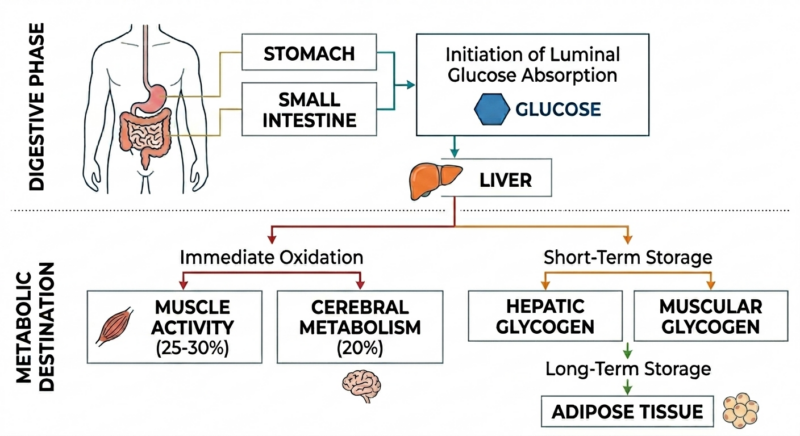
Glucose: Essential, but not harmless in Excess
Glucose is the body’s primary energy substrate and is essential for functions such as brain activity, muscle contraction and cellular repair. However, its homeostasis depends on a balance between insulin secretion, tissue sensitivity and the proper utilization of nutrients following food intake [1].
The issue does not lie in glucose itself, but in the speed and magnitude with which it appears in the bloodstream after a meal. When carbohydrates are digested and absorbed rapidly, postprandial glucose increases, along with the demand for insulin. Over time, repeated exposure to these spikes may increase metabolic load and reduce the efficiency of energy pathways [1].
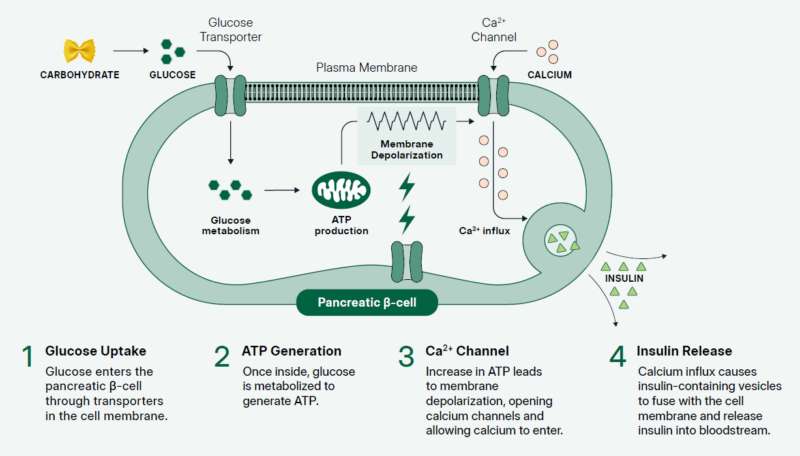
Source: Phynova Group Ltd
Beyond Sugar: Why the postprandial Response matters
Postprandial glucose spikes are increasingly considered relevant because they reflect how the body responds to food intake. Even in individuals without diabetes, the amplitude and duration of these spikes vary depending on diet composition, meal sequence, physical activity, time of day and individual metabolic status [1,2].
When these responses are more pronounced, insulin secretion also increases. From a physiological perspective, this may translate into sensations such as fatigue, brain fog, irritability or increased hunger in the hours following a meal, particularly when the glycemic curve is more abrupt [1].
Incretins, Digestion and Satiety
Postprandial glucose regulation does not rely exclusively on the pancreas. The small intestine plays an active role through incretins such as GIP and GLP-1, which are released in response to nutrients, including carbohydrates. These hormones enhance insulin secretion and coordinate the metabolic response after food intake [3].
In addition, the incretin axis directly links glycemic control with satiety. In the case of GLP-1, its role in slowing gastric emptying and modulating appetite reinforces the idea that glycemic balance and appetite control are two sides of the same physiological process [3,4].
Chrononutrition: Not only what we eat, but when
Glycemic response is also modulated by circadian rhythm. The interaction between the biological clock, hormones and metabolism means that the time of day influences how the body manages glucose. Evidence suggests that eating late or misaligned with biological rhythms may be associated with impaired glucose tolerance and a less favorable metabolic environment [2,4].

Stress and Sleep: Modulators of Metabolism
Glucocorticoids, such as cortisol, are part of the stress response and play a key role in regulating glycemic homeostasis by promoting hepatic gluconeogenesis and modulating glucose utilization in tissues [5].
Similarly, sleep deprivation is associated with alterations in carbohydrate metabolism and reduced insulin sensitivity. This is particularly relevant in a context of hyperconnectivity, irregular schedules and insufficient rest, where glycemic control may be compromised even without significant changes in diet [6].
Nutritional and Lifestyle Strategies to smooth the Glycemic Curve
One of the most relevant approaches is not to eliminate carbohydrates, but to modulate the rate of digestion and absorption, as well as the overall physiological response to food. In this regard, meal sequencing is emerging as a practical strategy. Recent studies show that consuming vegetables and proteins before carbohydrates improves time in range and reduces glycemic variability compared to the reverse pattern [7].
In addition, light physical activity after meals plays an important role. Walking after eating has been shown to improve postprandial glycemic response compared to rest, even with simple and easily applicable interventions [8].
Time in Range: From isolated Values to Metabolic Stability
Beyond fasting glucose or glycated hemoglobin (HbA1c), the concept of Time in Range (TIR) has gained relevance as a metric to assess glycemic stability. In current clinical practice, TIR is used to interpret continuous monitoring data and provides a more dynamic view of glycemic behavior throughout the day [9].
Although its use is more established in diabetes, this concept reinforces a key idea also in functional nutrition: metabolic health benefits from more stable and predictable glycemic patterns, not only acceptable average values [9].
A botanical Approach to supporting Metabolic Health
In this context, there is growing interest in ingredients capable of modulating postprandial glycemic response while remaining compatible with habitual dietary patterns. White mulberry (Morus alba) leaf has been widely studied for its ability to reduce glycemic and insulinemic responses when consumed together with carbohydrate sources [10,11].
In particular, studies with white mulberry extract have shown significant reductions in both postprandial glucose and insulin levels in healthy adults, whether consumed with maltodextrin or sucrose. This reinforces its relevance as an ingredient in formulations targeting glycemic balance and metabolic health [10,11].

Conclusion
Discussing glycemic balance today means discussing metabolism in its broader sense. The postprandial response integrates digestion, insulin, incretins, circadian rhythm, stress, sleep and eating behavior.
For this reason, metabolic health is no longer interpreted solely as the absence of clinical alterations, but as the body’s ability to respond efficiently, stably and flexibly to nutrients and environmental factors [1,2,3,4].
From a functional nutrition perspective, the challenge is not only to reduce spikes, but to build a more stable metabolic environment. Along this path, strategies such as meal sequencing, nutritional timing, postprandial activity and the use of specific botanical ingredients are becoming key tools for developing solutions aligned with human metabolic physiology [7,8,10,11].
Are you looking for the right ingredients?
Subscribe to our newsletter…
…or find our ingredients in the following product portfolio!
References
- The Science of Glucose Metabolism and Insulin Regulation. Phynova Group, 2026. https://8613539.fs1.hubspotusercontent-na1.net/hubfs/8613539/Reducose%20DeepDive-Glucose&Insulin_Digital_0526.pdf
- Sato, T., & Sato, S. (2023). Circadian regulation of metabolism: commitment to health and diseases.Endocrinology,164(7), bqad086.
- Seino, Y., Maekawa, R., Ogata, H., & Hayashi, Y. (2016). Carbohydrate‐induced secretion of glucose‐dependent insulinotropic polypeptide and glucagon‐like peptide‐1.Journal of diabetes investigation,7, 27-32.
- BaHammam, A. S., & Pirzada, A. (2023). Timing matters: the interplay between early mealtime, circadian rhythms, gene expression, circadian hormones, and metabolism—a narrative review.Clocks & sleep,5(3), 507-535.
- Kuo, T., McQueen, A., Chen, T. C., & Wang, J. C. (2015). Regulation of glucose homeostasis by glucocorticoids.Glucocorticoid signaling: from molecules to mice to man, 99-126.
- Montaruli, A., Castelli, L., Mulè, A., Scurati, R., Esposito, F., Galasso, L., & Roveda, E. (2021). Biological rhythm and chronotype: new perspectives in health.Biomolecules,11(4), 487.
- Touhamy II, S., Palepu, K., Karan, A., Hootman, K. C., Riad, J., Sripadrao, S., … & Shukla, A. P. (2025). Carbohydrates-last food order improves time in range and reduces glycemic variability.Diabetes Care,48(2), e15-e16.
- Bellini, A., Nicolò, A., Bazzucchi, I., & Sacchetti, M. (2022). The effects of postprandial walking on the glucose response after meals with different characteristics.Nutrients,14(5), 1080.
- ElSayed, N. A., McCoy, R. G., Aleppo, G., Balapattabi, K., Beverly, E. A., Early, B., … & Seley, J. J. (2025). 6. Glycemic Goals and Hypoglycemia: Standards of Care in Diabetes—2025.Diabetes Care,48, S128.
- Lown, M., Fuller, R., Lightowler, H., Fraser, A., Gallagher, A., Stuart, B., … & Lewith, G. (2017). Mulberry-extract improves glucose tolerance and decreases insulin concentrations in normoglycaemic adults: Results of a randomised double-blind placebo-controlled study.PLoS One,12(2), e0172239.
- Thondre, P. S., Lightowler, H., Ahlstrom, L., & Gallagher, A. (2021). Mulberry leaf extract improves glycaemic response and insulaemic response to sucrose in healthy subjects: results of a randomized, double blind, placebo-controlled study.Nutrition & metabolism,18(1), 41.