Mood & Stress
The Gut-Brain Axis: How Gut Microbiota Influences Mood
For years, the gut was considered an organ dedicated exclusively to intestinal transit. Today, we know that its influence goes far beyond digestion. The intestinal microbiota plays a role in a complex bidirectional communication network with the central nervous system, known as the gut-brain axis, which is capable of influencing processes related to stress, mood, cognitive function, and even sleep quality (1,2).
This discovery has generated enormous interest within the nutraceutical industry. The possibility of modulating the microbiota through different bioactive compounds opens new opportunities to develop solutions aimed at supporting emotional well-being and resilience to stress, two areas that rank among the major concerns of today’s consumers (1,3).
A Two-Way Connection
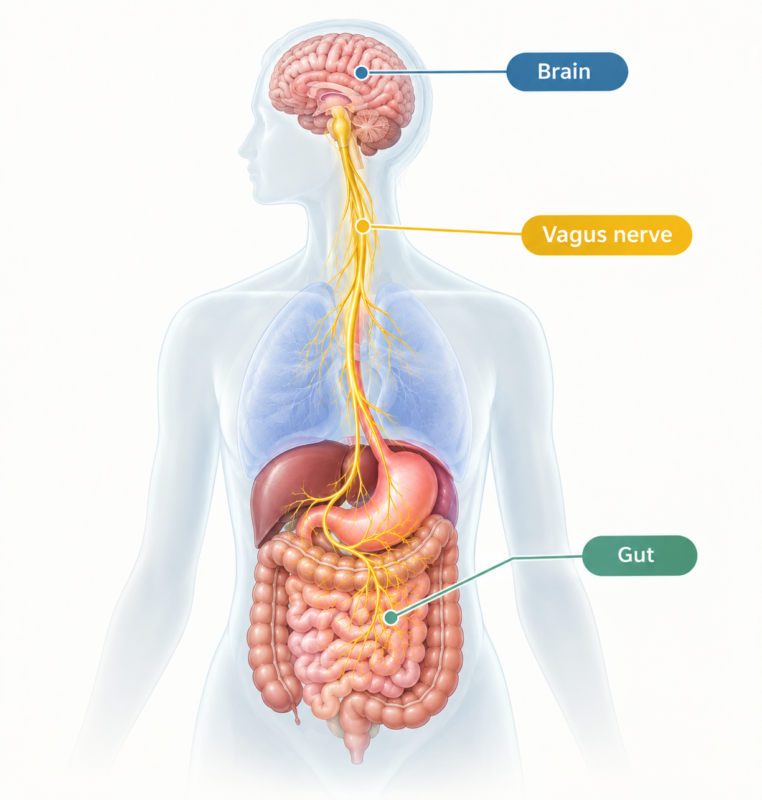
To understand the importance of this axis, it is useful to imagine a two-way highway. The brain constantly influences intestinal motility, digestive secretions and pain perception. At the same time, the gut sends information to the brain through the vagus nerve, including immune signals, hormones and/or metabolites produced by the microbiota. In addition, ongoing research in this field helps explain why stressful situations can alter digestive function and, conversely, why certain changes in the microbiota may influence emotional well-being (1,2).
It is therefore not surprising that periods of stress or nervousness may affect intestinal transit or that certain digestive disorders are more frequently associated with symptoms of anxiety or mood disturbances. One of the most interesting aspects of this relationship is that certain intestinal bacteria participate in the production or modulation of compounds related to brain function, including GABA, serotonin, dopamine and various metabolites derived from tryptophan. Although this does not mean that a bacterium can “manufacture happiness”, it does help explain why alterations in the microbiota may be associated with changes in emotional state (3,5).
The Role of Short-Chain Fatty Acids
A large part of this communication is mediated by the so-called short-chain fatty acids (SCFAs), such as acetate, propionate and butyrate. These compounds, produced by the microbiota during the fermentation of certain fibers, play a role in intestinal barrier integrity, immune regulation and various metabolic pathways related to the gut-brain axis (4).
The Intestinal Barrier: Much More Than a Wall
Another fundamental piece of this puzzle is the intestinal barrier. When the integrity of this barrier is compromised, certain bacterial molecules can enter the bloodstream and promote systemic inflammatory responses. Various studies have suggested that this low-grade inflammation could indirectly influence mechanisms related to stress, mood and certain neuropsychiatric disorders (5,6).
For this reason, an important part of current nutraceutical strategies focuses not only on increasing microbial diversity butalso on supporting barrier function and maintaining intestinal homeostasis (5,6).
What Are Psychobiotics?
As knowledge of the gut-brain axis continues to grow, a new concept has emerged within the sector: psychobiotics. This term encompasses microorganisms, prebiotics, or combinations thereof that are capable of positively or indirectly influencing functions related to mental well-being through the intestinal microbiota (3,7).
Different strains of Lactobacillus and Bifidobacterium have been the most extensively studied to date. Some clinical trials have reported improvements in parameters related to stress, anxiety, sleep or mood, although the results remain heterogeneous and depend on factors such as the strain used, dosage, duration of intervention and the population studied (3,7).
Beyond Traditional Probiotics
The growing understanding of the intestinal ecosystem is drawing attention to new bacterial species with different mechanismsof action, including Akkermansia muciniphila. Naturally present in healthy individuals, this species is characterized by its interaction with the mucin layer covering the intestinal epithelium, contributing to the maintenance of the intestinal barrier and the production of metabolites relevant to metabolic health (8,9).
Although its primary positioning remains linked to intestinal and metabolic health, its potential relationship with the gut-brain axis is attracting increasing interest. Proposed mechanisms include improvements in intestinal integrity, reductions in endotoxemia, in low-grade inflammation and the indirect modulation of signals capable of influencing overall well-being. Nevertheless, more human studies are still needed to establish clear conclusions regarding mood and mental health outcomes (8,9).
New Biological Communication Systems
If psychobiotics represent one of the most active areas of innovation, exosomes could become the next frontier of the gut-brain axis. One of the most promising emerging areas is the study of exosomes and other biological communication systems capable of acting through the gut-brain axis. Recent developments are exploring how certain probiotic strains may release extracellular vesicles capable of modulating pathways related to BDNF, cognition, stress or sleep quality (10,11).
Although this remains an emerging field, it perfectly illustrates the direction in which the sector is moving: from a vision focused solely on the microbiota toward understanding the gut as a complex signaling platform capable of influencing multiple physiological systems.
One of the Most Promising Trends in the Sector
Although many of these approaches still require further clinical research, the message is clear: the gut is no longer viewed solely as a digestive organ. Today, it is understood as a true center of biological communication capable of influencing processes related to immunity, metabolism, cognitive function, and even emotional well-being. For the nutraceutical industry, few areas currently offer as much innovation potential as the gut-brain axis (1,4).
Are you looking for the right ingredients?
Subscribe to our newsletter…
…or find our ingredients in the following product portfolio!
References
- Rosas-Sánchez, G. U., Germán-Ponciano, L. J., Puga-Olguín, A., Soto, M. E. F., Medina, A. Y. N., Muñoz-Carillo, J. L., … & Soria-Fregozo, C. (2025). Gut–brain axis in mood disorders: a narrative review of neurobiological insights and probiotic interventions. Biomedicines, 13(8), 1831.
- Loh, J. S., Mak, W. Q., Tan, L. K. S., Ng, C. X., Chan, H. H., Yeow, S. H., … & Khaw, K. Y. (2024). Microbiota–gut–brain axis and its therapeutic applications in neurodegenerative diseases. Signal Transduction and Targeted Therapy, 9(1), 37.
- Dziedzic, A., Maciak, K., Bliźniewska-Kowalska, K., Gałecka, M., Kobierecka, W., & Saluk, J. (2024). The power of psychobiotics in depression: A modern approach through the microbiota–gut–brain axis: A literature review. Nutrients, 16(7), 1054.
- Diotaiuti, P., Misiti, F., Marotta, G., Falese, L., Calabrò, G. E., & Mancone, S. (2025). The gut microbiome and its impact on mood and decision-making: A mechanistic and therapeutic review. Nutrients, 17(21), 3350.
- Eskandar, K. (2025). The gut–brain axis in depression, anxiety, and schizophrenia: A scoping review of mechanisms, biomarkers, and therapeutic implications. Middle East Current Psychiatry, 32(1), 87.
- Pletikosić Tončić, S., Hauser, G., & Tkalčić, M. (2024). Gut microbiota, mood and disorders of gut-brain axis. Microbiota Health and Disease, 6:e1098.
- Sisubalan, N., Kesika, P., Sivamaruthi, B. S., & Chaiyasut, C. (2026). Psychobiotics in mental health: Insights from human clinical trials via the gut-brain axis. Frontiers in Microbiology, 17, 1804560.
- Mount, S., Canfora, E. E., Jocken, J. W., Umanets, A., Hul, G., Coenjaerds, M., … & Blaak, E. E. (2026). Pasteurized Akkermansia muciniphila MucT for weight loss maintenance in people with overweight and obesity: A controlled randomized trial. Nature Medicine, 1-10.
- Derrien, M., Vaughan, E. E., Plugge, C. M., & de Vos, W. M. (2004). Akkermansia muciniphila gen. nov., sp. nov., a human intestinal mucin-degrading bacterium. International Journal of Systematic and Evolutionary Microbiology, 54(5), 1469-1476.
- Yuan, D., Zhao, Y., Banks, W. A., Bullock, K. M., Haney, M., Batrakova, E., & Kabanov, A. V. (2017). Macrophage exosomes as natural nanocarriers for protein delivery to inflamed brain. Biomaterials, 142, 1-12.
- Lin, C. E., Chen, L. F., Fang, W. H., Chang, C. C., & Chang, H. A. (2025). ExoBDNF Probiotic Supplementation Enhances Cognition in Subjective Cognitive Decline. Medicina, 62(1), 91.